Radon
NOTICE: Due to high demand, the Onondaga County Health Department has distributed all available radon test kits at this time.
If you are interested in testing your home’s radon levels, please check your local home stores, online retailers, or the New York State Department of Health for radon detection kits available for purchase.
What is Radon?
Radon is an invisible radioactive gas found in soil and rocks. It seeps into your home through cracks in the foundation, walls and joints. Radon is the leading cause of lung cancer in non-smokers and the second leading cause in smokers. Based on United States Environmental Protection Agency (EPA) estimates lung cancer due to radon exposure claims about 21,000 US lives annually.
Radon May Be a Health Risk for You and Your Family
|
Radon Level |
If 1,000 people who smoked were exposed to this level over a lifetime… |
If 1,000 people who never smoked were exposed to this level over a lifetime… |
|---|---|---|
|
20 pCi/L |
About 260 people could get lung cancer |
About 36 people could get lung cancer |
|
4 pCi/L |
About 62 people could get lung cancer |
About 7 people could get lung cancer |
|
0.4 pCi/L |
About 3 people could get lung cancer |
Less than 1 person could get lung cancer |
Source: “A Citizen’s Guide to Radon” US EPA, Jan 2009
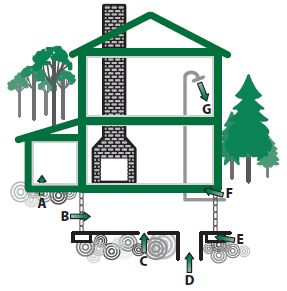
Radon Entry Routes
Any home can have high radon levels, whether it is old or new, has a basement or is built on a slab. Radon can leak through cracks in your basement or slab, through the dirt floor of your crawl space, or through openings around your sump pump.
Major Radon Entry Routes:
A. Cracks in concrete slab
B. Pores and cracks in concrete blocks
C. Slab-footing joints
D. Exposed soil, as in sump
E. Cracks between poured concrete (slab) and blocks
F. Loose fitting pipes
G. Water
Onondaga County is considered a High Risk County for Radon in New York State.
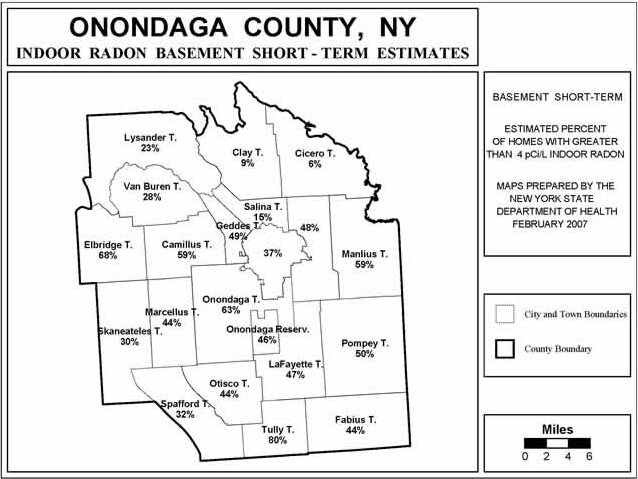
This local map can help you determine if you live in an area that is prone to high radon levels. The average basement radon level in Onondaga County is 8.1 pCi/L. According to current data, almost 50% of the homes tested in Onondaga County have levels of radon above the EPA recommended limit of 4 pCi/L. View the test results in your town.
How do I find out if my house has radon?
The only way to tell if you have radon in your home is to test.
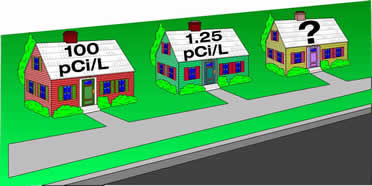
What should I do if
My Home Has Radon Levels Above 4 pCi/L?
The EPA recommends that you fix your home if the test shows a radon level above 4 pCi/L.
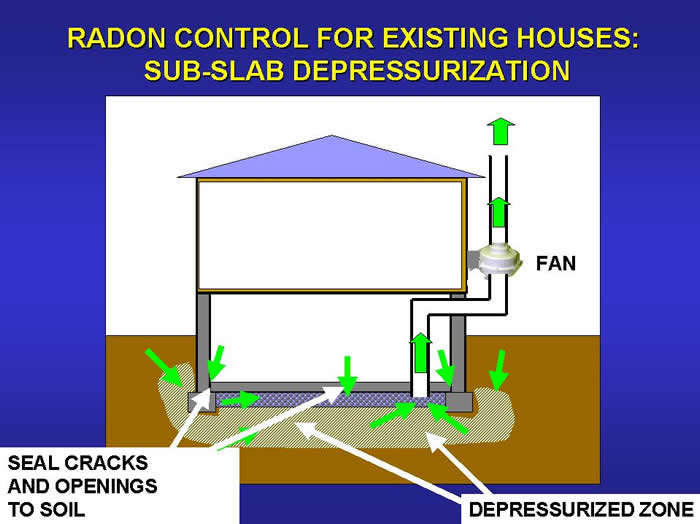
Radon levels in a house can be reduced by installing a radon mitigation system. A qualified radon mitigation contractor can design and install a system for your house.
For more information about radon, call 315.435.1649 or visit:
New York State Department of Health and the U.S. Environmental Protection Agency