
Weather Hazards to Be Prepared For
When preparing for any type of weather hazard there are important steps to follow that apply to every hazard. It starts with reviewing your family’s emergency plan and checking your go kit to ensure all items are included, up to date, and not expired. Replace anything missing before a storm approaches.
Stay alert to forecasts. If severe weather is predicted, begin preparing early and continue monitoring updates as the storm gets closer. Make sure your phone can receive Wireless Emergency Alerts (WEAs) and that your shelter area is accessible.
On the day of the storm, stay aware of watches and be ready to act quickly if a warning is issued. Review your communication plan and ensure everyone knows how to reach safety.
Household Hazards to Be Prepared For
Household Chemical Safety
Nearly every household uses products that contain hazardous materials or chemicals. Knowing how to store, use, and dispose of these products can significantly reduce the risk of injury.
Before a Household Chemical Emergency
When you practice safe storage and smart habits with objects that have chemicals it can help prevent accidents. Here are a list of common household items that contain chemicals that could be harmful.
Store Hazardous Household Chemicals Safely
During a Household Chemical Emergency
If a chemical emergency is imminent remember to act quickly to protect yourself and others. Leave immediately if there is any danger of a fire or explosion. Always stay upwind and away from the building to avoid breathing toxic fumes. Here are the signs you should be able to recognize if someone has been exposed to a toxic poisoning.
If someone shows symptoms or has been exposed to a chemical: Call the national poison control center at 800‑222‑1222. Follow the operator’s instructions carefully.
Do not rely on first aid instructions printed on containers—they may be outdated. Do not give anything by mouth unless instructed by a medical professional.
After a Household Chemical Emergency
After a chemical emergency occurs it should be a priority to reduce lingering risks. Discard any clothing that may have been contaminated. Some chemicals cannot be fully removed, even after washing.
Facts About Hazardous Materials
Hazardous materials are not just radioactive or poisonous materials, they can also include flammable and combustible substances, as well as poisonous vapors, aerosols, liquids, and solids that have toxic effects on people, animals, or plants. Emergencies related to hazardous materials can happen at any time, whether it is during the creation, storage, transportation, use, or disposal of the materials. Signs of a chemical release include difficulty breathing, eye irritation, loss of coordination, nausea, or burning in the nose, throat, and lungs. The presence of many dead insects or birds may indicate a chemical agent release.
Before an Incident Occurs
It is important to create a plan before a chemical agent release occurs. To learn more information about what chemicals or hazardous materials could affect the area you may live or work in, send a request to our email at emweb01@ongov.net. We will work to get that information to you as soon as we have received your request.
When an Incident Occurs
Hazardous materials, chemical spills, and radiation incidents can happen fast. That is why it is important ahead of time to know what to do before, during, and after an incident occurs.
If an incident does occur it is important to stay informed on what is occurring whether it is from our department, elected officials, local radio, or a television station. All of these sources will be able to provide up‑to‑date information on what is occurring and the instructions you will need to follow. Depending on the scope of the incident those directions may change from sheltering in place to evacuating an area entirely. The tips below are credited to and provided by FEMA and Ready.gov.
After an Incident
Once an incident has occurred it is important to wait for authorities to declare it is safe to either go outdoors or return home. It is important to wait until the area has been declared safe. If you become affected by a chemical agent seek immediate help. If help is not available, the best action is to decontaminate yourself and help others do so too if possible.
To learn more about Hazardous materials, chemical spills and radiation click here to head to our webpage.
Fire Safety Tips Before and During a Fire
Our Fire Bureau is committed to reinforcing essential safety tips for preventing fires, preparing before an emergency, and knowing what to do if a fire occurs. Fire moves quickly — in less than 30 seconds, a small flame can grow into a major fire. Below are important steps you can take to help keep your home and family safe.
Smoke Alarms
According to the American Red Cross If you have a fire, smoke alarms can cut nearly in half your risk of dying in a fire. Smoke alarms sense abnormal amounts of smoke or invisible combustion gases in the air. They can detect both smoldering and flaming fires. In new homes smoke alarms are required to be present on every level of the home, outside each sleeping area, and inside each bedroom. Alarms must be wired together so that if one sounds, they all sound.
|
Working smoke alarms provide early warning in case of fire. |
|
Install smoke alarms on every level of your home. |
|
Install smoke alarms on every level of your home. |
|
Test alarms monthly to ensure they work properly. |
|
Replace alarms every 10 years or sooner if they don’t function. |
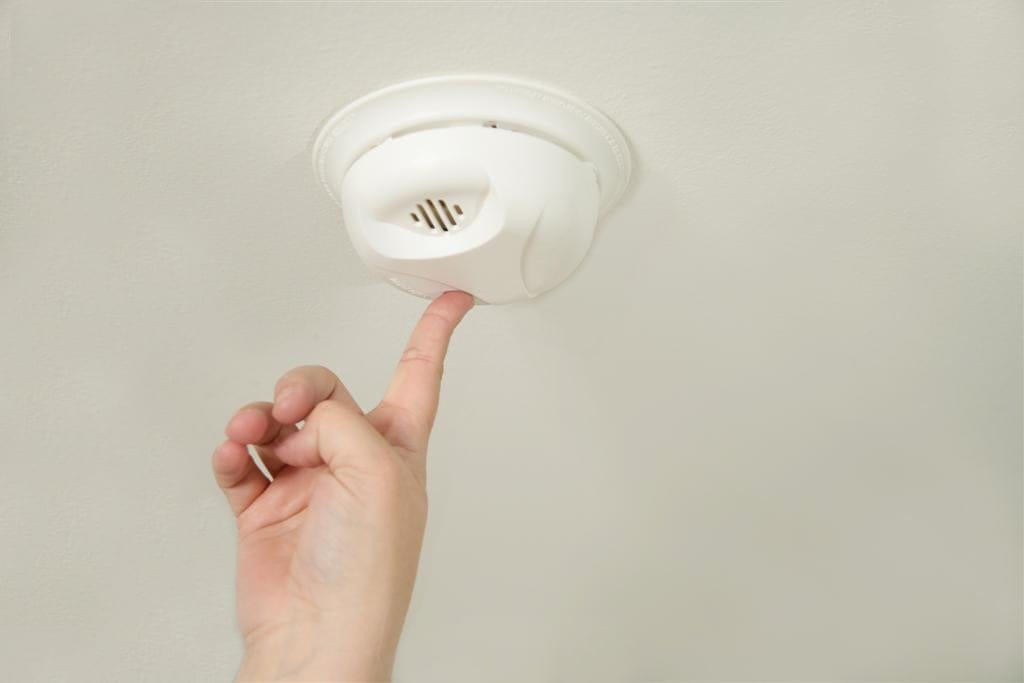
If you are unable to acquire a smoke detector. Click the link here to contact the American Red Cross.
Fire Extinguishers
With proper training and education, fire extinguishers can save lives and protect property. Your local fire department is a great resource for fire extinguisher training and can answer questions community members may have including extinguisher disposal. Make sure fire extinguishers are accessible in your home, and that everyone in the household knows how to use them safely and effectively.
Fire Extinguisher Classification
|
Class A fire extinguisher use |
Should be used on ordinary materials like cloth, wood and paper. |
|
Class B fire extinguisher use |
Should be used on combustible and flammable liquids like grease, gasoline, oil and oil-based paints. |
|
Class C fire extinguisher use |
Should be used on electrical equipment like appliances, tools or other equipment that is plugged into an outlet. |
For household use consider using an ABC class extinguisher which can be used on all of the above fires. You can purchase one at your local retailers.
How to Use a Fire Extinguisher: The PASS Method
|
P – Pull the pin |
This unlocks the extinguisher and allows you to discharge it. |
|
A – Aim low |
Point the nozzle or hose at the base of the fire, not the flames. |
|
S – Squeeze the handle |
This releases the extinguishing agent. Maintain firm, controlled pressure. |
|
S – Sweep side to side |
Move the nozzle from side to side at the base of the fire until it appears to be out. Watch the area in case the fire reignites. |
Fire Escape Plan:
Make a plan. Talk to your family about what to do if there is a fire.
|
Know two ways out of every room. |
|
Have a meeting place outside your home. |
|
Know how to call 911 from outside to report a fire. |
|
Practice your escape plan with everyone who lives in your home at least twice a year. |
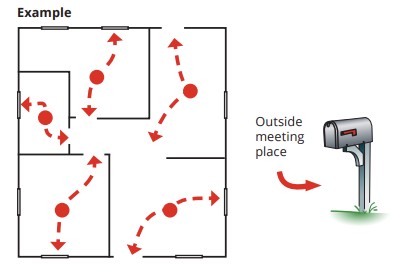
Picture Credit: United States Fire Administration.
Credit: Portions of the information on this page are adapted from materials provided by the American Red Cross and the American Heart Association. Their guidance served as a foundation and was tailored to include preparedness information specific to Onondaga County.
Power outages can result from various causes, such as severe weather or falling trees. Being prepared and knowing what steps to take when the power goes out is essential.
Power outage tips
1. Prior to an outage assemble your kit and make sure it has everything you need before to handle the outage.
2. Talk to your doctor to make a plan for how you will use your medical devices that need electricity.
3. Consider having a generator on hand for backup power, but make sure that it is being used safely outdoors to prevent carbon monoxide poisoning.
Utilities
When the power goes out, it’s important to turn off and secure your utilities. Be sure to switch off circuit breakers and fuses, and know how to shut off your water supply. As you prepare to take these actions, remember to check beforehand whether you have the necessary tools to complete them. If not, investing in those tools ahead of time can greatly benefit your household and assist safety crews during emergencies.
When the power goes out, you may need to stay warm for several hours. Here are some helpful tips to retain heat in your home.
1. Stuff towels or rags in cracks under doors.
2. Close blinds or curtains to keep in some heat.
3. Close off rooms to avoid wasting heat.
Power Outage Maps
National Grid has created an interactive map that is updated every 5 minutes and provides regional power restoration information.
Click here to open the map and look at National Grid power outages in your area.
Click here to open the map and look at NYSEG power outages in your area.
Power Outage Alerts
You can sign up to receive alerts via text, phone call or email when your power goes out. National Grid and NYSEG will notify you when they detect an outage on your property, have restoration estimates and updates, or have restored power to your address.
Click here to learn how to sign up for National Grid’s alerts.
Click here to learn how to sign up for NYSEG’s alerts.
Power Outage Restoration Process
Click here to learn more about National Grid’s restoration process.
Being prepared in the digital world means staying safe while using the internet, digital devices, and online platforms. Cybersecurity breaches can occur at any time, whether you are at work, at home, or connected to public Wi‑Fi in a shared space. Below are some tips you can consistently follow to help protect yourself online.
1. Be aware of common email scams. Specifically phishing emails.
2. Use strong and unique passwords.
3. Do not click on untrusted links.
4. Do not give away personal information to anyone online.
Nearly every aspect of society depends heavily on networked technologies—from phones and communication systems to home appliances, security systems, transportation networks, medical infrastructure, and utility services. This interconnectedness enables more efficient and effective services, but it also increases vulnerability to cyber incidents with potentially devastating consequences. A disruption in one organization or system—whether caused by natural hazards, human error, equipment failure, or malicious attacks—can ripple across entire networks.
To learn more about cybersecurity click here to head to our page on cybersecurity.
Essential Home Preparation Tasks
Click here to learn more about how to make a plan today. Your family may not be together if a disaster strikes. It is important to know which types of disasters could affect your area and how to prepare for them.
There are four crucial steps in developing a plan.
Step 1: Put a plan together by discussing the questions below with your family, friends, or household to start your emergency plan.
Step 2: Consider specific needs in your household. Every household will have to prepare in a different way, as each has unique needs for what will help in an emergency. It is your responsibility to discuss and identify those specific needs. They should be included in your plan. Some of those factors could be the following.
STEP 3: Create a Family Emergency Plan.
Step 4: Practice your plan with your family/household. Practicing your family preparedness plan is crucial to ensure that everyone knows how to respond in case of an emergency. By practicing your plan, you also enhance communication, reduce panic, improve response, and build trust.
Step 5: Create a Family Reunification Plan.
Emergencies can separate families without warning. A reunification plan helps ensure that everyone knows how to reconnect quickly and safely, whether the disruption is caused by an evacuation, shelter‑in‑place order, school closure, or communication outage. Planning ahead reduces stress, speeds up recovery, and helps emergency responders focus on those who need immediate assistance.
Creating Your Reunification Plan:
Start by identifying the people you need to reconnect with after an emergency. Choose at least one meeting location near your home and another outside your neighborhood in case local roads or buildings are unsafe. Make sure every family member knows these locations and understands when to use each one.
Select an out‑of‑area contact who can help relay information if local phone lines are overloaded. Share this person’s name and number with all household members, including children who are old enough to memorize or carry it. If someone becomes separated, they should check in with this contact as soon as they are able.
Include schools, workplaces, and care providers in your plan. Confirm how each organization communicates during emergencies and where they relocate children or staff if evacuation becomes necessary. Make sure your reunification plan aligns with their procedures so everyone knows what to expect.
Having a shelter and evacuation plan is crucial—disasters can strike when you’re away from home, or your household may be directly in the path of severe weather. Being prepared ensures everyone knows what to do and where to go.
Mass Care shelters Plan
Mass care shelters play a vital role in supporting disaster survivors by providing essentials like food, water, medicine, and sanitation. However, these resources may be limited or not tailored to your specific needs. That’s why it’s important to bring your own emergency supply kit to ensure you’re fully prepared.
Sheltering in Place Plan
Sheltering in place can happen at a moment’s notice, anywhere and anytime. Whether you’re at home, at work, or in another familiar location, there may be situations where staying put is the safest option. That’s why it’s important to have a shelter-in-place plan for every area where you spend significant time. Review these plans with your household, coworkers, or anyone else who shares those spaces with you.
Stay-at-Home Plan
When staying at home during an emergency, it’s important to remain indoors as much as possible and only go out when absolutely necessary. You can still use outdoor areas like patios, porches, and yards for fresh air and light activity. Outdoor exercises such as walking or jogging are generally safe. Essential errands—like grocery shopping, visiting the pharmacy, refueling at the gas station, or going to the Post Office—are still permitted when needed.
Evacuation plan
Onondaga County does not have a designated evacuation building for residents to evacuate to. When an evacuation is ordered, it’s critical to know when to leave and where to go. Having a clear plan in place can save valuable time—and most importantly, lives. Make sure you know what to pack in your go-bag and where it’s stored so you’re not scrambling during an emergency.
After an Evacuation
After an evacuation, be prepared for disruptions to daily activities, and remember that returning home before storm debris is cleared can be dangerous. Bring essential supplies like water and non-perishable food for the trip back. Avoid downed power or utility lines—they may be live and extremely hazardous. Stay clear and report them immediately to your utility provider. If using a generator, operate it only outdoors and away from your home. Never run a generator inside a house or garage, and do not connect it directly to your home’s electrical system.
Returning Home Plan
When returning home after an evacuation, never go back until local officials have declared the area safe. Let someone know your destination and confirm when you arrive. Once home, inspect the property for structural damage before entering to ensure it’s safe.
To learn more about sheltering and evacuation click here to head to our webpage.
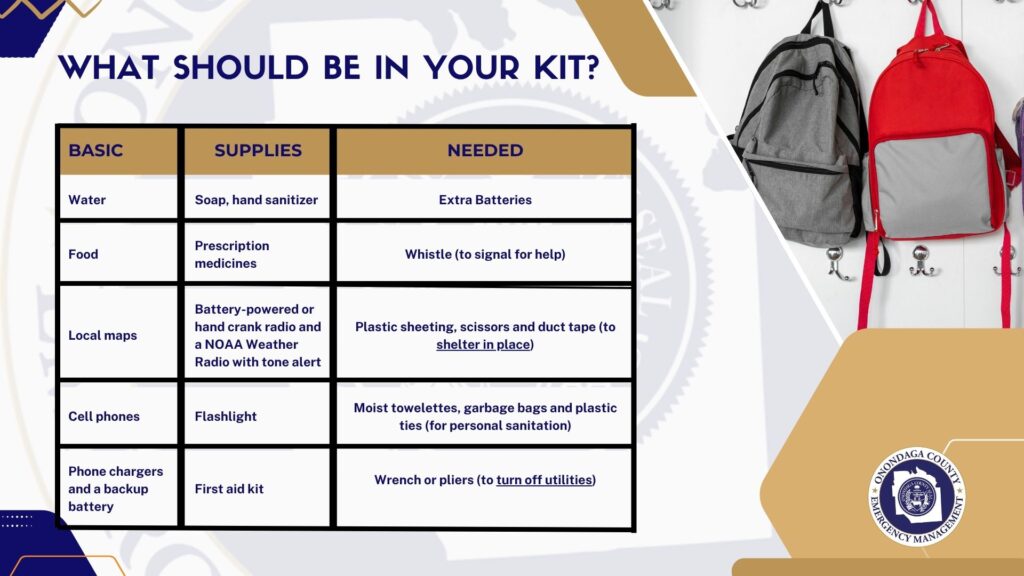
Click here—or on the image below—to learn what essential items to pack in your emergency “go kit.”
First aid is the immediate assistance given to someone experiencing an injury or sudden illness before professional medical help is available. Its primary goals are to preserve life, prevent the condition from worsening, and support recovery.
By signing up with the Red Cross and learning how to respond to common medical emergencies, you can become a valuable resource to your household and community during a crisis.
Every household should have a well-stocked first aid kit. Some essential items to include are:
|
Adhesive bandages (various sizes) |
Sterile gauze pads and adhesive tape |
|
Antiseptic wipes and antibiotic ointment |
Tweezers and scissors |
|
Disposable gloves |
Thermometer |
|
Pain relievers (e.g., acetaminophen or ibuprofen) |
Instant cold packs |
|
CPR face shield or mask |
First aid manual or instruction booklet |
|
Emergency contact information |
Any personal medications or medical supplies |
Properly installing and maintaining alarms in your home—such as smoke detectors and carbon monoxide alarms—can save lives. It’s just as important to test them annually to ensure they’re working correctly and ready to alert you in an emergency.
Carbon Monoxide
Carbon Monoxide (CO) is known as the “silent killer” because it’s a colorless, odorless, and tasteless gas that can cause severe physical harm or even death. When installing CO alarms in your home, keep in mind that placement guidelines may vary by manufacturer—always follow the instructions provided with each device. For maximum protection, install alarms near sleeping areas, in every bedroom, and on every level of your home. New York State law requires a carbon monoxide alarm in every dwelling unit.
Tips for avoiding Carbon monoxide
|
Never use unventilated portable heating units indoors. They can produce dangerous gases like carbon monoxide. |
|
Do not operate damaged furnaces, boilers, or heaters. Malfunctioning equipment can pose serious fire and health risks. |
|
Never run portable electrical generators indoors. Use them only outside and away from windows, doors, and vents to prevent carbon monoxide buildup. |
|
Keep vents clear. Ensure that dryer, furnace, stove, and fireplace vents are free of snow, ice, and debris to allow proper ventilation and prevent carbon monoxide accumulation. |
Smoke Detectors
Install smoke alarms in every bedroom, outside each sleeping area, and on every level of your home—including the basement. Larger homes may require additional alarms to ensure full coverage. For the best protection, use interconnected smoke alarms so that when one sounds, they all sound, alerting everyone in the home simultaneously.
If the smoke alarm sounds, get outside immediately and stay outside. Go directly to your designated outdoor meeting place. Call the fire department using a cellphone or a neighbor’s phone. Do not re-enter the building until the fire department confirms it is safe to do so.
Fire Extinguisher
With proper training and education, fire extinguishers can save lives and protect property. Your local fire department is a great resource for fire extinguisher training and can answer questions community members may have. Make sure fire extinguishers are accessible in your home, and that everyone in the household knows how to use them safely and effectively.
Fire Extinguisher Classification
|
Classification:
|
Use:
|
|
Class A fire extinguisher use |
Should be used on ordinary materials like cloth, wood and paper. |
|
Class B fire extinguisher use |
Should be used on combustible and flammable liquids like grease, gasoline, oil and oil-based paints. |
|
Class C fire extinguisher use |
Should be used on electrical equipment like appliances, tools or other equipment that is plugged into an outlet. |
How to Use a Fire Extinguisher: The PASS Method
|
P – Pull the pin |
This unlocks the extinguisher and allows you to discharge it. |
|
A – Aim low |
Point the nozzle or hose at the base of the fire, not the flames. |
|
S – Squeeze the handle |
This releases the extinguishing agent. Maintain firm, controlled pressure. |
|
S – Sweep side to side |
Move the nozzle from side to side at the base of the fire until it appears to be out. Watch the area in case the fire reignites. |
Different tasks to prepare for
Insurance:
When your property is at risk from severe weather or other emergencies, it’s essential to ensure your insurance coverage is up to date. Review your homeowners or renters insurance policy before disaster strikes so you understand exactly what is—and isn’t—covered. Keep in mind that most policies do not include flood damage. While preparing, create an inventory of your belongings, including a detailed list and photographic records of important items and valuables. Store copies of your insurance documents and other critical records in a secure location outside your home.
Boil water advisory
According to the Centers for Disease Control and Prevention (CDC), water utilities or government agencies may issue drinking water advisories when tap water is—or could be—contaminated with harmful substances such as germs, chemicals, toxins, or radioactive materials. These advisories offer specific guidance to help you avoid illness from unsafe water. As a precaution, a boil water notice is often issued. If you’re ever uncertain about the quality of your tap water, it’s safest to boil it before use. When a boil water advisory is in effect, do not store water in sinks or bathtubs. Do not use un-boiled tap water to drink, prepare food, or brush your teeth. Additionally, do not give un boiled water to pets.
What to do when trapped
While it is hard to prepare for being trapped there are some tips that could help you escape entrapment if it every arises. The first thing to remember is to try not to panic, instead aim to stay calm and ask yourself these questions:
1. Can you get to a cell phone or telephone to call for help?
2. Can you verbally call for help?
3. What is trapping you? Is it a blocked exit, debris, or an injury.
4. Can you move whatever is blocking your exit?