
Agricultural Districts
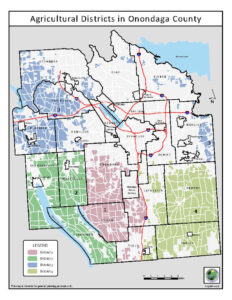
New York’s Agricultural Districts Law was enacted in 1971 to “conserve, protect, and encourage the development and improvement of its agricultural land for production of food and other agricultural products, and as valued natural and ecological resources which provide needed open spaces for clean air sheds and aesthetic purposes.”

Responsibility for the creation of agricultural districts and the ongoing maintenance of district boundaries lies within the authority of the state’s county legislative bodies. The Onondaga County Legislature, with the assistance of the Agriculture and Farmland Protection Board and the Department of Planning, oversee this process including required eight-year reviews and annual additions (inclusions).

There are four agricultural districts in Onondaga County that encompass approximately 11,192 parcels on 200,848 acres of land in 23 municipalities including 17 towns and five villages. Districts are required by the law to consist predominantly (more than 50 percent) of viable agricultural land.


Viable agricultural land is defined by the law as land that is highly suitable for a farm operation.  A farm operation is the land and on-farm buildings, equipment, manure processing and handling facilities, and practices which contribute to the production, preparation and marketing of crops, and livestock and livestock products as a commercial enterprise.  Horse boarding, equine, timber, and compost, mulch or other biomass crops also qualify under specific statutory rules.  A comprehensive list of specific commodities and special provisions are detailed in the law. 

To qualify as a commercial enterprise, a farm operation must generally consist of at least seven acres of land used in agricultural production that generates an average gross sales value of $10,000 or more annually for the preceding two years.  Exceptions and additional requirements are detailed in the law.

Farm operations within an agricultural district are afforded the following benefits and protections:


  • requires state agencies to modify administrative regulations and procedures to encourage the maintenance of viable farming;
  • limits the exercise of eminent domain and other public acquisitions, and the advance of public funds for certain construction activities;
  • limits the power to impose benefit assessments, special ad valorem levies, or other rates or fees in certain benefit areas or improvement districts such as water, sewer, and non-farm drainage;
  • limits unreasonable local restrictions and regulations of farm operations;
  • requires municipal agricultural data statement reviews for certain planning and zoning actions that impact a farm operation;
  • provides Right-to-Farm provisions for protection from private nuisance suits;
  • requires agricultural district disclosure notice for real estate transactions involving property within an agricultural district;
  • establishes the agricultural assessment program that allows reduced property tax bills for eligible farmland in agricultural production (which is not required to be in a district); and
  • provides for a five-year rather than eight-year conversion penalty period for landowners who receive an agricultural assessment.

Being within an agricultural district does not:


  • restrict the use of property for agricultural production, or otherwise prohibit other uses;
  • change the local municipal zoning designation;
  • restrict the sale or lease of property; or
  • directly reduce or increase tax assessments—owners of agricultural must apply to the local tax assessor to receive an annual agricultural assessment.


NYS Department of Agriculture and Markets Administration

While the Onondaga County Legislature is responsible for the creation of agricultural districts, the NYS Department of Agriculture and Markets (NYSAGM) is responsible for administering many of the law’s protections and benefits.


  • issuing opinions on the soundness of specific agricultural practices;
  • reviewing the reasonableness of local laws on agriculture;
  • reviewing the impacts of publicly funded projects on farm operations through the Notices of Intent process;
  • assisting with administering the agricultural assessment program; and
  • hosting the Advisory Council on Agriculture.

Eight-Year Reviews

Agricultural districts are required to be reviewed by the Onondaga County Legislature and certified by the NYS Department of Agriculture and Markets Commissioner every eight years.  During the review’s open enrollment period between January 1 – 30, landowners can request to remove their land from the district and/or to add their viable agricultural land to the district.

The eight-year review process for the four districts in Onondaga County is staggered every two years as follows: 

District 1 – 2026, 2034…
District 2 – 2028, 2036…
District 3 – 2030, 2038…
District 4 – 2032, 2040…


The next eight-year review will be Agricultural District 2 in 2028.   The review process will start in November – December of 2027.  Documents will be posted below as they become available.

November – December
The Onondaga County Legislature announces an eight-year review through a public notice that is published in the Post Standard/Syracuse.com and is posted on the county website and in at least five conspicuous places within the district.  Announcements are also posted on county social media accounts and shared with affected local municipalities and local agricultural service providers including the local USDA offices in LaFayette, Onondaga County Soil and Water Conservation District, and Cornell Cooperative Extension – Onondaga County.

January
In addition, all landowners with property in the agricultural district receive a mailing that includes a detailed list of that property.  Landowners do not need to take any action if they would like their property to simply remain in the district.  Otherwise, landowners have the option to submit a form requesting to remove their land and/or add their viable agricultural land during a 30-day open enrollment period between January 1 – 30.

February – March
The Onondaga County Agriculture & Farmland Protection Board is directed by the Onondaga County Legislature to prepare a report that considers the following as required by the law:


  • the nature and status of farming and farm resources within the district, including the total number of acres of land and the total number of acres of land in farm operations in the district;
  • the extent to which the district has achieved its original objectives;
  • the extent to which county and local comprehensive plans, policies and objectives are consistent with and support the district;
  • the degree of coordination between local laws, ordinances, rules and regulations that apply to farm operations in such district and their influence on farming; and
  • landowner requests to remove and/or add property to the district.

April – June
The Onondaga County Agriculture & Farmland Protection Board forwards the report with a recommendation to continue, terminate, or modify (landowner requests) the district to the Onondaga County Legislature for their consideration and to schedule and hold a public hearing.  The public notice for the hearing is published in the Post Standard/Syracuse.com and posted on the county website.  Announcements are also posted on county social media accounts and shared with any landowners that submitted requests, affected local municipalities, and local agricultural service providers.  

Following the public hearing the Onondaga County Legislature makes a finding to continue, terminate, or modify (landowner requests) the district.  The report and findings are then submitted to the Commissioner of the New York State Department of Agriculture and Markets for certification. 

July – August
The Commissioner of the New York State Department of Agriculture and Markets reviews and certifies the Onondaga County Legislature findings and notifies the county.  The county then notifies affected municipalities and landowners.


Annual Additions (Inclusions)

Agricultural Districts Law requires counties to provide landowners with an annual 30-day period to submit requests to add predominately viable agricultural land to an existing district.  The Onondaga County Legislature designated January 1-30 of each year as the annual 30-day open enrollment period in Onondaga County.


Each year the annual process begins in November to December.  Documents will be posted here as they become available.

November – December
A public announcement for the annual open enrollment period is shared with the Post Standard/Syracuse.com and posted on the county website.  Announcements are also shared on county social media accounts and with local agricultural service providers including the local USDA offices in LaFayette, Onondaga County Soil and Water Conservation District, and Cornell Cooperative Extension – Onondaga County.

January
During the January 1 -30 open enrollment period, landowners can submit a form requesting to add property that contains predominately viable agricultural land to any of the four districts in the county.

February – March
The Onondaga County Agriculture & Farmland Protection Board is directed by the Onondaga County Legislature to prepare a report detailing any landowner requests and to make recommendations on the request(s). 

April – May
The Onondaga County Agriculture & Farmland Protection Board then forwards the report and recommendations to the Onondaga County Legislature for their consideration and to schedule and hold a public hearing.  The official public notice for the hearing is published in the Post Standard/Syracuse.com and posted on the county website.  Announcements are also posted on county social media accounts and shared with any landowners that submitted requests, affected local municipalities, and local agricultural service providers.

June
Following the public hearing the Onondaga County Legislature makes a finding on the addition (inclusion) of predominately viable agricultural lands to an agricultural district(s).  The report and findings are then submitted to the commissioner of the New York State Department of Agriculture and Markets for certification. 

July – August
The Commissioner of the New York State Department of Agriculture and Markets reviews and certifies the Onondaga County Legislature findings and notifies the county.  The county then notifies affected municipalities and landowners.


Agricultural Data Statements


Local municipalities are responsible for requiring an agricultural data statement for planning and zoning actions within and surrounding an agricultural district and to evaluate and consider possible impacts of the proposed action on farm operations within the district.


Local actions include any application for a special use permit, site plan approval, use variance, or subdivision approval requiring municipal review and approval by a planning board, zoning board of appeals, town board, or village board of trustees that would occur on property containing a farm operation within an agricultural district and on property with boundaries within five hundred feet of a farm operation located in an agricultural district.

The agricultural data statement is used to evaluate and consider possible impacts of the proposed action on farm operations within the district.


Real Estate Transaction Disclosures


Real property transactions located partially or wholly within an agricultural district require a disclosure notice.  The disclosure notice advises that farming activities within the district might cause noise, dust, and odors and must be signed by the purchaser and seller prior to the transaction.


A disclosure notice typically reads as follows: 

It is the policy of this state and this community to conserve, protect and encourage the development and improvement of agricultural land for the production of food and other products, and also for its natural and ecological value. This disclosure notice is to inform prospective residents that the property they are about to acquire lies partially or wholly within an agricultural district and that farming activities occur within the district.

Such farming activities may include, but not limited to, activities that cause noise, dust and odors. Prospective residents are also informed that the location of property within an agricultural district may impact the ability to access water and/or sewer services for such property under certain circumstances. Prospective purchasers are urged to contact the New York State Department of Agriculture and Markets to obtain additional information or clarification regarding their rights and obligations under Article 25-AA of the Agricultural and Markets Law.