
Evidence Collection & Submission Manual – How to Submit Evidence
The Center for Forensic Sciences – Forensic Laboratories has policies and procedures for the transportation, receipt, handling, protection, storage, retention and/or disposal of test items. These procedures include all provisions necessary to protect the integrity of the test item and to protect the interests of the CFS and the customer.
Acceptance of Evidence
Evidence must be submitted in a container to protect the items from loss, cross-transfer and/or contamination and must be properly sealed.
The evidence may be received in person, via mail or from on-site temporary storage lockers.
The CFS will maintain temporary secured storage lockers and refrigerators for law enforcement personnel to secure their evidence prior to submission to the CFS. The evidence stored in these locations is not considered received until the evidence comes into the possession of the CFS personnel and is accessioned.
Proper Seals
The CFS requires that the evidence accepted and stored in the laboratories is properly sealed. Evidence is properly sealed only if its contents cannot readily escape and only if entering the package/container will result in obvious damage/alteration to the outer package/container or its seal. Typically, a proper seal consists of heat seals or tape seals. Various other sealing procedures may meet this definition.
A proper seal for evidence submitted to the CFS must at a minimum be initialed or otherwise marked to document the person sealing the evidence.
It is recognized that not all evidence can be packaged and sealed (e.g. bulky items such as furniture, etc.).If it is not practical to package a piece of evidence, contact the CFS prior to submission.
BEAST-LIMS: System of Identification
An electronic bar-coded evidence analysis statistical tracking – laboratory information system (BEAST-LIMS) is used to maintain the identification of the items throughout the life of the items in the CFS. The BEAST-LIMS requires the use of an electronic signature or a personal identification number (PIN) for any transfer involving an individual. The system is designed and operated so as to ensure that items cannot be confused physically or when referred to in records or other documents. The laboratories must be able to demonstrate that the evidence examined and reported on was in fact the item(s) submitted to the CFS. A “chain of custody” record, which reflects the receipt of evidence and all internal transfers, is maintained utilizing the BEAST-LIMS. The electronic record details each person taking possession of an item of evidence, or the location of that item.
Secure Web Access
Agencies that are not located in Onondaga County who desire the services of the CFS may gain access to a secure web pre-log account. Please contact the Director of Laboratories at 315-435-3800 if interested.
Evidence Submission Form and Chain of Custody Continuation Form
The CFS provides the Evidence Submission Form (ESF) (Figure 1) and Chain of Custody Continuation Form (CCC) (Figure 2) to submitting agencies that are not part of the BEAST or web pre-log systems.
The ESF is a four-ply form that is to be used for the submission of evidence to the CFS Laboratories. The CCC is also a four-ply form to be used when chain of custody transactions must extend to additional pages.
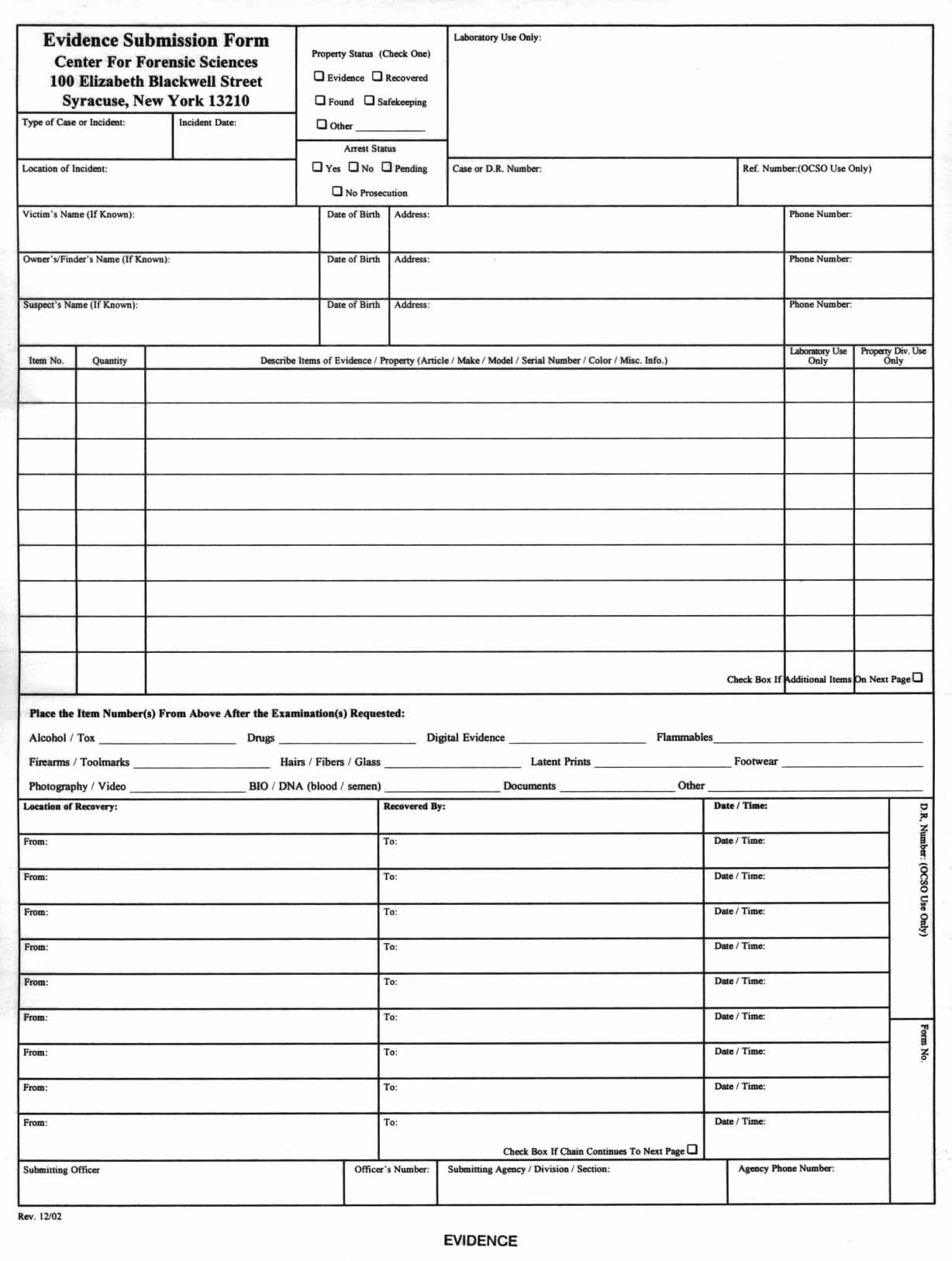
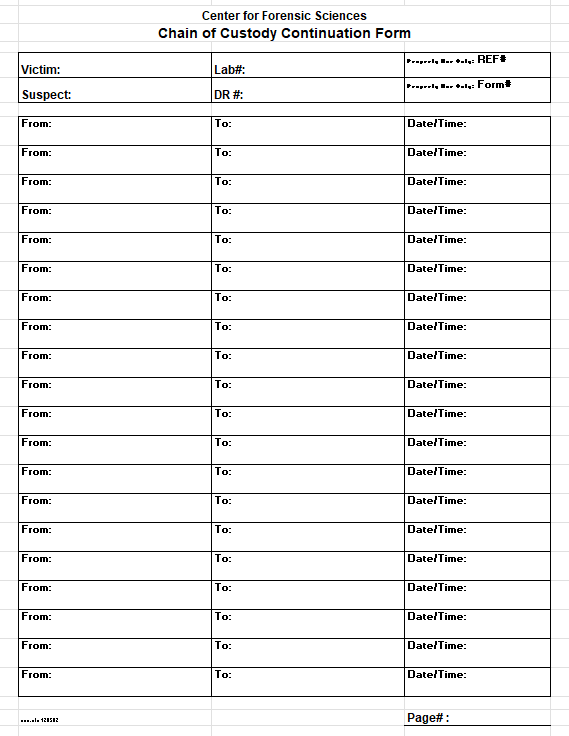
ESF/CCC Page Descriptions:
- ESF/CCC sheet is the original ‘Evidence’ chain of custody. The original remains at the CFS (along with copy #2) for as long as the evidence is in the custody of the CFS. When evidence is released to the submitting agency, the original ESF/CCC shall be transferred with the evidence.
- ESF/CCC sheet is the ‘Case File’ copy and is an official laboratory record of the chain of custody. This sheet is maintained in the CFS case record.
- ESF/CCC sheet is the ‘Records’ submitting agency copy.
- ESF/CCC sheet is the ‘Submitting Officer’ copy. The submitting officer may take this copy upon delivery of the evidence to the CFS.
At a minimum, the top two sheets marked ‘Evidence’ and ‘Case File’ must be submitted with the evidence. The CFS will not accept evidence that is submitted without these top two sheets. (Exception: Evidence being re-submitted may be accompanied by sheet #1, as sheet #2 will be in the CFS case record.) If the ‘Records’ and ‘Submitting Officer’ copies are also submitted with the evidence (i.e. may be included with items left in lockers), these copies will be destroyed. It will not be the responsibility of the CFS to forward these copies to the Records divisions of any agency
Mailing / Commercial Carriers
Certain regulations of the U.S. Postal Service cover the mailing of certain types of evidence. Liquid biological fluids such as urine or blood specimens must be packaged in a securely sealed primary container with sufficient shock-resistant material to withstand shock and pressure changes. An absorbent material should surround the primary container or otherwise be configured to take up the contents in case of a leakage. There should also be an outer shipping container with secondary leak-proof materials so that, if there is leakage of the primary container during shipment, the contents will not escape from the outer container.
The packaging and marking requirements for evidence of blood and body fluids are based on the OSHA Bloodborne Pathogen Standards, CFR Title 29 1910.1030, and on U.S. Postal Regulations, Domestic Mail Manual, C010. Other courier services may have additional requirements.
General Evidence Packaging and Safety Considerations
All evidence received at the CFS upon receipt, during examination, and post-examination will be stored under appropriate conditions to ensure that the integrity of the evidence is not compromised. Much of the evidence collected by law enforcement agencies is potentially hazardous. The hazards relate to the types of exposure individuals may have with the items of evidence. Four common methods of exposure are inhalation, absorption, ingestion, and injection. The risk of exposure can be reduced by using appropriate packaging materials and the placement of hazard warnings on the exterior of the evidence containers.
The CFS maintains secured evidence rooms, refrigerators and freezers, and individual storage areas for short and long-term evidence storage.
Examples of Properly Packaged Evidence
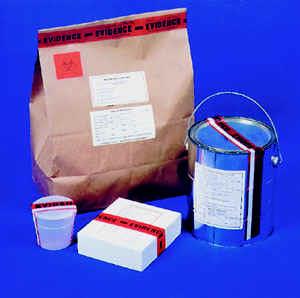
Biological Items (Liquid Blood and Other Liquid Bodily Fluids)
Liquid blood and urine should be packaged in a crush-proof container that will contain all contents and
prevent leakage during handling, storage, and transport. Label with the international biohazard symbol and warning label.
Sharp Objects
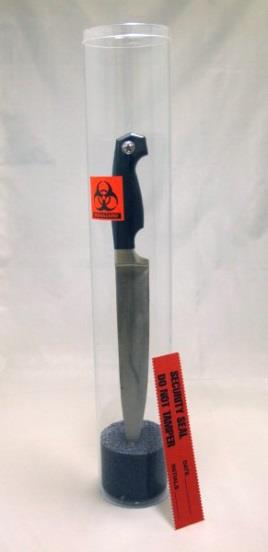
A sharp is any object capable of puncturing the skin. Sharp objects must be packaged in a
way to ensure the safety of the handler of these items. Sharp objects should be packaged
in rigid, puncture-resistant, and leak-proof containers.
Air holes in the outside container are important if Biology/DNA analysis is needed for the
item.
Sharps include glass tubes, razor blades, scalpel blades, knives, hypodermic syringes and
needles*, and other items capable of cutting or penetrating the skin.
Proper packaging may include: plastic tubes, metal cans, hard cardboard boxes, or any
container that prevents the sharp object from protruding through the surface of the
container that holds it.
Label the outside packaging with the words “WARNING: CONTAINS SHARPS”.
If needed, please use the international biohazard symbol.

Because of the possibility of an accidental needle puncture, hypodermic syringes with needles pose a health and safety threat both to contributors and to CFS personnel. The CFS will not accept hypodermic syringes as evidence. Injection of a bloodborne pathogen such as HIV (AIDS virus), HBV (hepatitis virus), and others can occur by the accidental exposure to blood or body-fluid-contaminated sharps.
Review: Items NOT examined by the CFS Laboratories
Firearms
Long guns and hand guns stored in boxes should be tape sealed in such a way to prevent entry into any of the three sides of the box that can be opened. Weapons need to be properly secured for safety.
The CFS will only accept firearms that have been unloaded and rendered safe with the action secured in an open position with nylon cable ties, chamber plugs, or some other mechanism that ensures the action will not accidentally discharge.
Submitting agencies are instructed to place loose ammunition recovered from the firearm inside a separate package within the outer packaging of the firearm.
Firearms that cannot physically be cleared (i.e. rusted shut, damaged or unsafe to unload, etc.) or firearms in which the loaded/unloaded status is not readily established (i.e. muzzle loaders/black powder type firearms) require contacting the Firearms Section at 315-435-3800 prior to their submission.
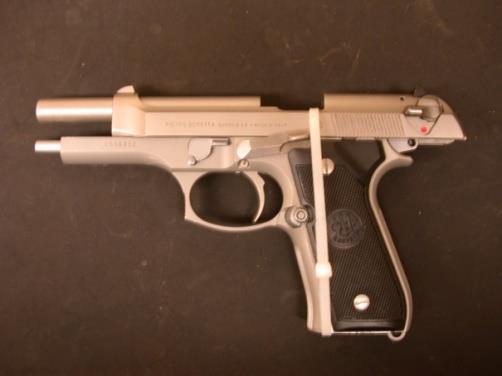
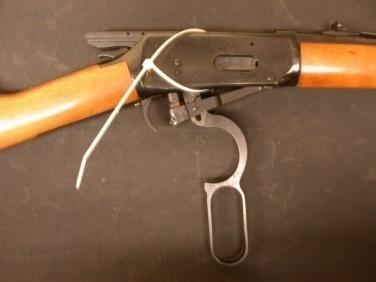
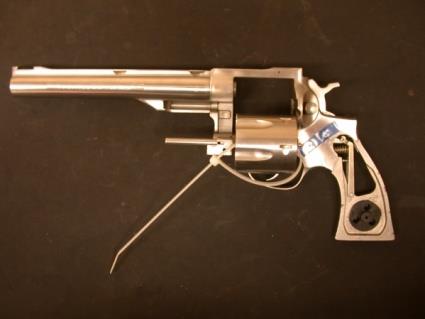

IMPORTANT!
NEVER place safety ties through the trigger guard!
Items NOT Examined by the CFS Laboratories

- Live explosives will not be accepted for examination.
- Small arms ammunition is not considered an explosive or explosive device for the purpose of this procedure and may be submitted for forensic examination.
- An explosive device ‘rendered safe’ may be accepted under certain circumstances.
- The decision to accept or reject the submission of a device shall rest with the Director of Laboratories or his/her designee.

- Large quantities of hazardous chemicals will not be accepted, including poisons such as arsenic, rat poison and ethylene glycol.

- Syringes/needles for analysis or storage due to biological, chemical, or physical safety hazards will not be accepted.
- The Director of Laboratories, or his/her designee, must approve any deviation from this policy.
- If approved for submission, a syringe/needle must be packaged properly following the packaging requirements for sharp objects, or it will not be accepted.

- Chemicals from clandestine laboratories will not be accepted due to the extreme danger of the chemicals present (e.g. methamphetamine lab); only the final product (e.g. methamphetamine) will be accepted.
In general, the CFS will not re-examine evidence previously analyzed by another accredited laboratory when to do so would duplicate a previous examination. This does not preclude examination of previously analyzed evidence with newer technologies that may provide additional information. This also does not prohibit examination of previously examined evidence if requested to do so by the agency that initially examined the evidence and if agreed to by the CFS Director of Laboratories.
Exceptions: The nature of our mission requires the CFS to handle a wide variety of submissions from a large number of agencies. This variety dictates flexibility in evidence handling methods. Deviations from the policy/procedure are anticipated.