
Evidence Collection & Submission Manual – CFS Evidence Submission Guidelines – Latent Prints
Latent Prints
Molly Corvo, Senior Latent Print Examiner
The Latent Prints section is responsible for developing fingerprints, palm prints, and footprints from items of evidence using various chemicals, powders, dye stains and light sources. The Latent Prints section is also responsible for comparing recovered latent prints to known prints of individuals for the purposes of identification. This can also be accomplished by searching unidentified latent prints in the Statewide Automated Biometric Identification System (SABIS) and the Federal Bureau of Investigation Next Generation Identification System (NGI).
Items that may yield a probative latent print for cases without an arrest should be submitted to the CFS for latent print analysis if needed for an investigation at the request of a law enforcement agency. Evidence from cases with an arrest should be submitted for latent print analysis at the request of the prosecuting attorney’s office unless special circumstances are communicated to the CFS (e.g. a known second suspect is unidentified). The CFS reserves the right to request elimination prints prior to latent print comparisons on a case by case basis.
Submission Guidelines
- Homicides
- In major cases it is valuable to have a meeting with CFS staff, detectives, attorneys, and crime scene personnel to prioritize evidence and to discuss the case in its entirety to ensure the best and most efficient analysis occurs. Prior to homicide evidence being submitted for analysis (with the exception of firearms evidence), a meeting between the submitting agency, attorney’s office (if applicable), and CFS staff of all relevant sections may occur.
- Analysis of Firearms-related Evidence for Latent Prints
- All handguns (except those voluntarily surrendered or for safekeeping) and shortened or defaced long guns submitted to the CFS will be automatically examined for latent prints (LP), but the agency/attorney is encouraged to still officially make an LP request.
- Long guns will only be examined for latent prints if there is an LP request made by the agency/attorney.
- Suicide weapons should not be submitted for firearms, latent print and/or DNA analysis unless deemed necessary by the submitting agency.
- Due to the extremely low chance of recovering latent prints from fired cartridge cases, latent print analysis will not be performed on fired cartridge cases (with the exception of shot shells) unless there is information to believe the items were handled after firing.
- Residential Burglaries and Recovered Vehicle Crimes
- For any residential burglary or recovered stolen vehicle cases, the CFS requests that the agency (other than the Syracuse Police Department) submit elimination prints, or provide information to the CFS for access to an electronic equivalent (i.e. name, NYSID# or FBI# for live-scan or RICI), prior to commencement of laboratory analysis.
Proper Collection / Proper Handling
- If the item has been disturbed or is out of place consider collecting and submitting for latent print analysis.
- When possible, appropriate elimination prints for people with legitimate access should be obtained.
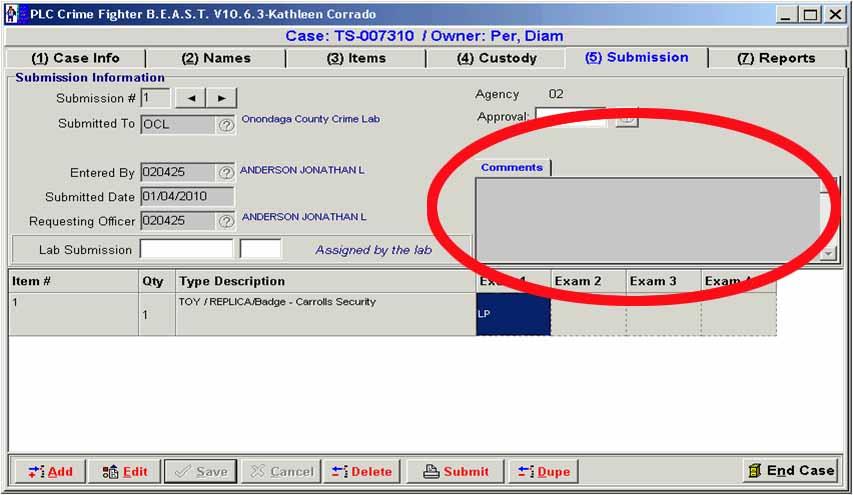
- Gloves should be worn while handling evidence. Please indicate in police report (or preferably in the BEAST “Comment” area of the Submission tab whether any officer touched the items without gloves so that elimination prints can be obtained if needed.
- Only black, white, or bi-chromatic fingerprint powders should be used if possible.
- Wet or bloody surfaces should not be powdered.
- Visible (patent) prints should be photographed with a scale prior to lifting.
- Items should be handled in a way that minimizes destruction of latent prints due to their fragile nature (grasping item through packaging should also be avoided).
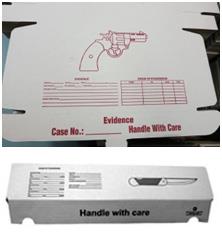
Optimal Packaging for Non-Porous Items (e.g., plastic, metal):
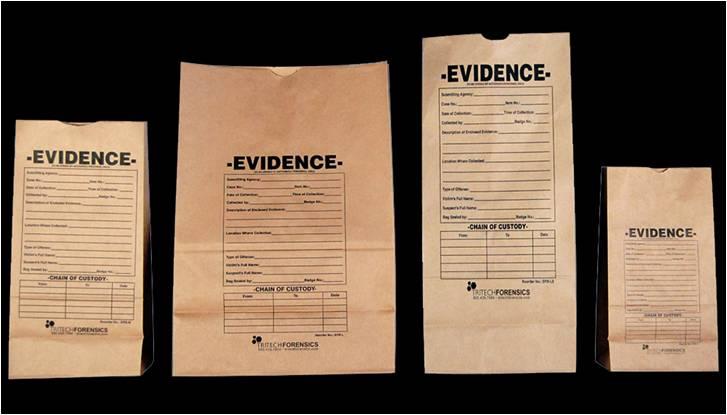
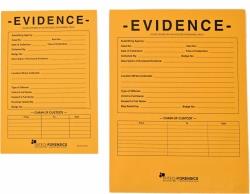
Good Packaging for Porous (paper-type) Items:
Multiple porous items can be submitted together.
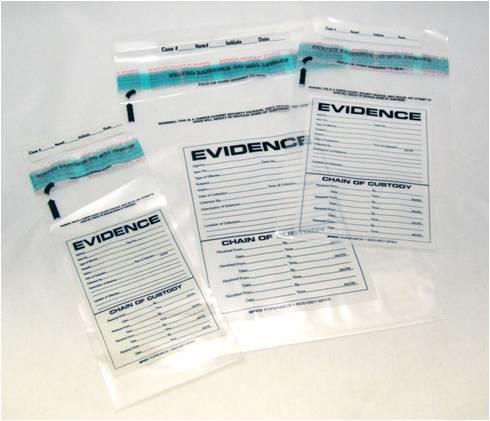
Duct tape removed from victim:
Please do NOT wad up tape into a ball and submit it in a paper bag. Tape can be laid out, adhesive side down onto acetate sheets and then packaged. Tape can also be secured in a box with pins to prevent movement, adhesive side up.
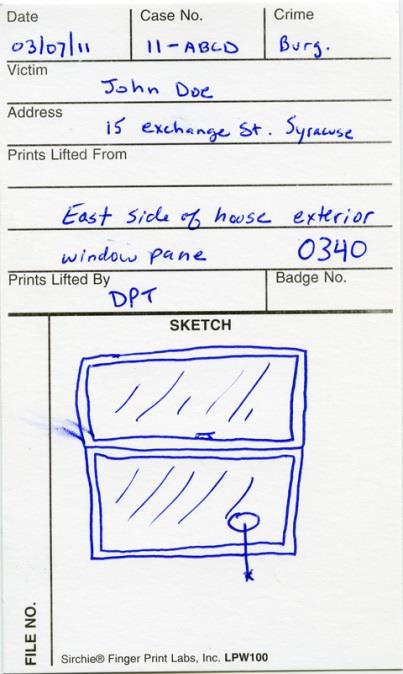
For Lifts:
Please include the following:
- Date
- Location of Lift
- Case #
- Lifting Officer
- A sketch of where latent print was located
If fingerprints of the officer lifting the latent prints accidentally show on the sticky side of the tape, an “X” and their initials should be placed over the officer’s prints. This will alert the Latent Print Examiner that these prints don’t require analysis.
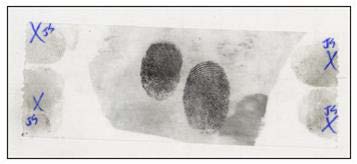
All lifts recovered should be retained for possible analysis. Even if the lift may not appear to be useful to the recovering officer, this determination should be made by the CFS Latent Print Section.
Known Prints for Comparison:
Please provide the following for suspects or victims if not submitting known prints as evidence through BEAST so the lab can attempt to obtain prints from RICI, DCJS , or the FBI:
- First and last name (middle initial if known).
- NYSID and/or FBI number if available.
- Biographical data to assist in locating a fingerprint record (i.e., DOB, Soc. Sec. #).
- Information can be included in the Comments box on the Submission Tab in BEAST when making requests for latent print exams.
- If the request for an exam was already made, the information should be provided to the Sr. Latent Print Examiner via phone or email.
Obtaining Elimination Prints
If obtaining elimination prints for comparison, ensure that they are recorded as clearly and completely as possible.
Example of Poor Quality of Elimination Prints:

Example of Better Quality of Elimination Prints:

Submission of Digital Images of Latent Prints to the CFS:
- Per the Scientific Working Group on Imaging Technology (SWGIT) and the Scientific Working Group on Friction Ridge Analysis (SWGFAST) Guidelines, the image should be captured at 1000 ppi or greater and shall be stored or transmitted without compression or with lossless compression. Please include a scale in photo.
- Digital Images of latent prints should be recorded on digital media (CD, DVD, or thumb drive), placed in a sealed container and submitted as evidence through BEAST.
- Be clear to differentiate if the CD/DVD contains photos of latent prints or if the CD itself needs to be processed to recover latent prints.